Louis Sullivan
The father of the modern skyscraper. The man who said “form follows function”. The mentor of Frank Lloyd Wright.
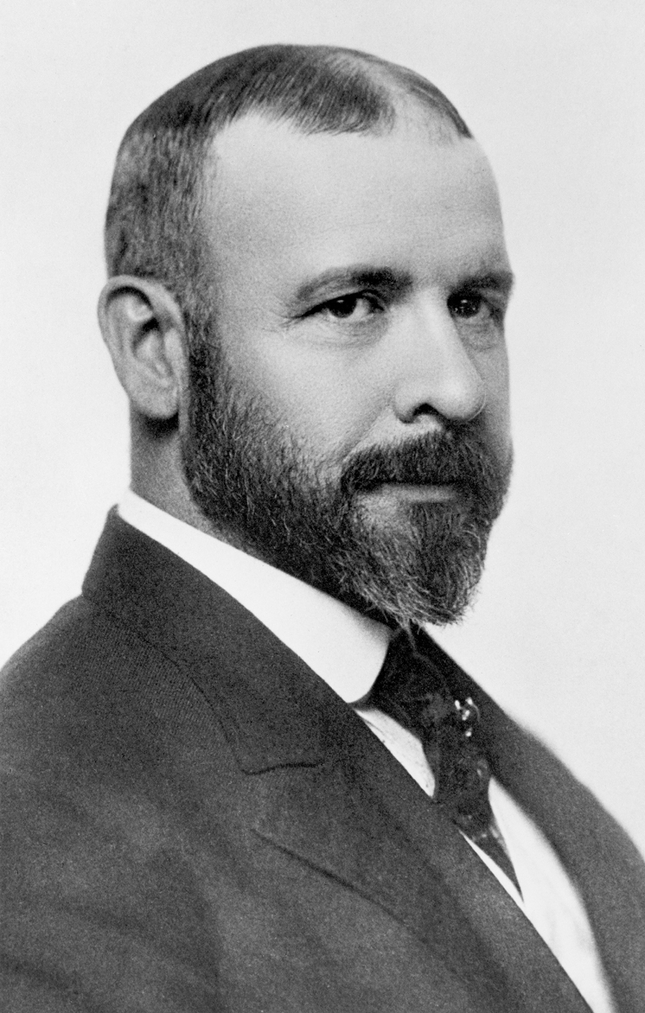
Louis Henry Sullivan was born in Boston on 3 September 1856 — the date now observed each year as Skyscraper Day. He died in Chicago on 14 April 1924, leaving behind a body of work that defined what a tall building could look like.
A new building for a new age
When Sullivan started his practice, American cities were exploding in population and commerce. The elevator and the steel frame had just made it technically possible to build very tall — but no one knew yet what such a building should look like. Sullivan’s answer was radical: stop dressing buildings up in classical fancy dress. Let them be what they are.
“It is the pervading law of all things organic and inorganic, of all things physical and metaphysical, of all things human and all things superhuman, of all true manifestations of the head, of the heart, of the soul, that the life is recognizable in its expression, that form ever follows function. This is the law.” — Louis Sullivan, The Tall Office Building Artistically Considered, 1896
An American Art Nouveau
Sullivan’s buildings achieved a rare elegance. Simple, vertically expressive forms were combined with elaborate organic ornamentation — foliage, vines, geometric tracery — that he designed by hand. He created his own uniquely American brand of Art Nouveau, decades before Europe gave that movement a name.
Selected works
Wainwright Building
St. Louis, 1891
One of the earliest steel-framed skyscrapers and a clear statement of vertical expression — a base, a shaft of repeating offices, and a richly ornamented cornice.
Guaranty Building
Buffalo, 1896
Thirteen stories of terracotta-clad steel, every surface alive with Sullivan’s organic ornament. Still standing, still inspiring.
Auditorium Building
Chicago, 1889
A massive mixed-use complex with hotel, offices and one of the great acoustic theatres in the world — designed with his partner Dankmar Adler.
Sullivan Center (Carson, Pirie, Scott)
Chicago, 1899/1903
A department store whose lower floors are some of the most exuberantly ornamented cast-iron facades ever built.
Mentor to Frank Lloyd Wright
For six years a young draftsman named Frank Lloyd Wright worked at Sullivan’s firm Adler & Sullivan. Wright called him Lieber Meister — “dear master” — for the rest of his life. The Prairie style, the Usonian house, Fallingwater, the Guggenheim — all of it traces back, in Wright’s own telling, to Sullivan. Read more about Frank Lloyd Wright →
Why we still talk about him
Every modern skyscraper — the Empire State, the Sears/Willis, One World Trade Center, the Burj Khalifa — is descended from the ideas Sullivan first put into stone, steel and terracotta in Chicago and St. Louis in the 1890s. That is why his birthday is the day we celebrate them all.
Want to dive deeper into the world of tall buildings?
SKYDB is a free, community-driven database of skyscrapers and high-rise buildings worldwide. Create your free account — explore, follow, and contribute.
Join SKYDB →